
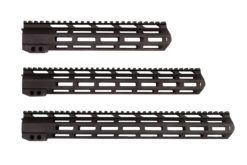
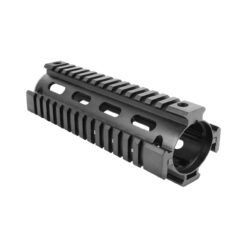
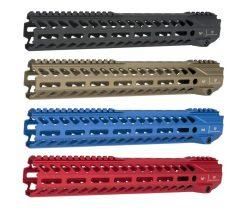
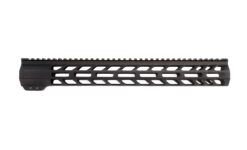
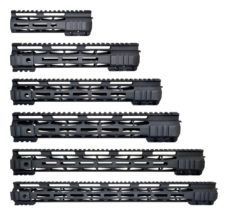
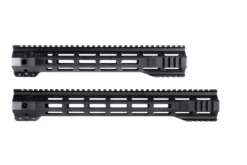
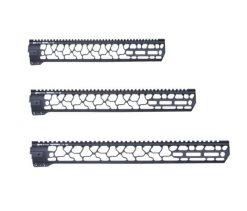
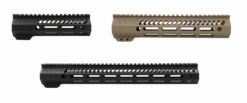
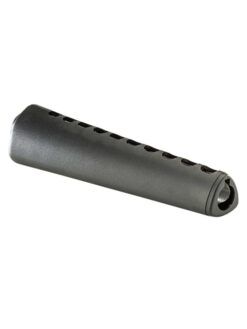
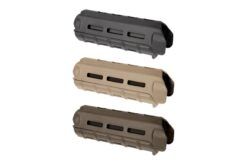
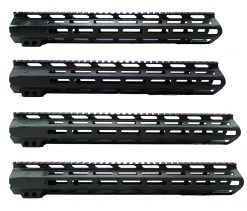
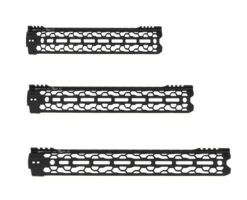
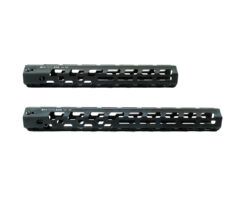
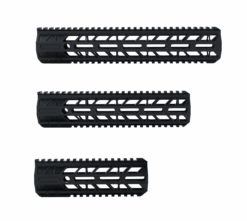
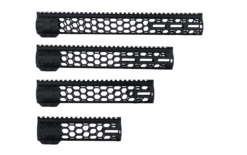
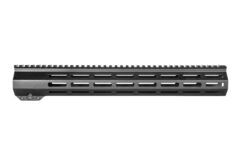
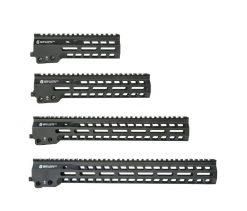
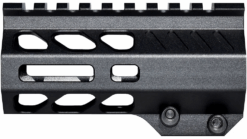
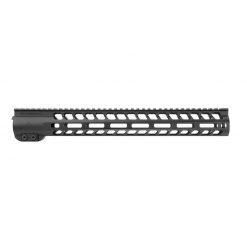
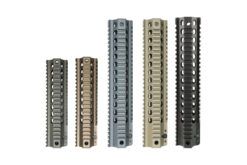
Whether you need a streamlined AR-15 handguard for a lightweight build, a durable quad rail for a clone-inspired rifle, or a premium Geissele handguard, compare the platform, length, mounting system, inside diameter, and included hardware before ordering.
Choosing Handguards for Your Build
The correct handguard must fit the firearm platform, barrel length, gas system, gas block, and upper-receiver configuration. AR-15 and AR-10 handguards are not automatically interchangeable, and some large-frame rifles use manufacturer-specific mounting dimensions.
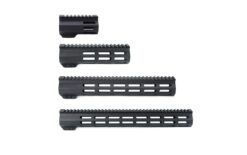
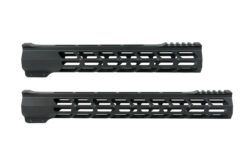
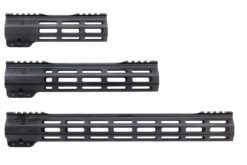
A free-float M-LOK handguard attaches around the barrel nut without contacting the barrel. This design provides mounting space for lights, grips, sling hardware, bipods, and other accessories while keeping unnecessary weight down. Quad rails provide continuous Picatinny mounting surfaces, while drop-in designs may install around the existing front sight base and delta-ring assembly.
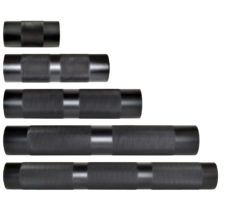
Available options may include an Aero Precision handguard, Magpul handguard, carbon-fiber handguard, PRI handguard, clone-style M4 RAS handguard, and rails for supported AK or MP5 configurations. Always confirm the exact platform rather than assuming an AR handguard will fit another firearm.
Handguard Length and Clearance
Choose a length that works with the barrel, muzzle device, and gas-system configuration. The handguard must also have enough inside diameter to clear the gas block and any components installed underneath it.
Review the product listing to determine whether the barrel nut, wrench, screws, anti-rotation parts, or other mounting hardware are included. Most mounting systems are proprietary, so an existing barrel nut should not be reused unless the manufacturer specifically confirms compatibility.
Shop handguards at AR15Discounts to compare free-float, M-LOK, Picatinny, drop-in, and platform-specific options for your next build or upgrade.
Frequently Asked Questions About Handguards
Choosing a handguard involves more than selecting a preferred length or rail style. These frequently asked questions cover the compatibility, clearance, hardware, and installation details buyers should verify before ordering.
What should I confirm before ordering a handguard for my AR platform?
Confirm the receiver platform, handguard length, barrel length, gas-system configuration, gas-block clearance, mounting method, inside diameter, and included hardware. Large-frame AR platforms may use different receiver and barrel-nut patterns.
Are AR-15 and AR-10 handguards interchangeable?
No. AR-10 and other large-frame rifles do not share one universal standard, and their handguards are generally not interchangeable with AR-15 components. Match the handguard to the exact receiver and barrel-nut pattern.
Does a handguard normally include the barrel nut and mounting hardware?
Many free-float handguards include a proprietary barrel nut and mounting hardware, but inclusions vary. Review the product specifications before ordering.
Can I reuse my existing barrel nut with a new handguard?
Only when the new handguard is specifically designed for that barrel nut. Most free-float systems use proprietary barrel nuts and mounting components.
How do I know whether a handguard will clear my gas block?
Compare the handguard’s inside diameter with the gas block’s height and width. Also verify that the gas block is intended to fit beneath the selected rail.
What does the inside diameter of a handguard mean?
Inside diameter measures the available space within the handguard. It determines whether the rail can clear the gas block, muzzle device, or other components positioned underneath it.
Why do some handguards have anti-rotation tabs?
Anti-rotation tabs help prevent the handguard from twisting around the barrel nut. Their design and upper-receiver compatibility vary by manufacturer.
Can M-LOK accessories be used with a Picatinny handguard?
Direct-mount M-LOK accessories require M-LOK slots. A Picatinny handguard may require an appropriate rail-mounted version of the accessory or a compatible adapter.
What can cause a handguard to loosen or shift after installation?
Possible causes include incorrect installation, improper fastener torque, missing locking components, an incompatible barrel nut, damaged hardware, or failure to follow the manufacturer’s installation procedure.